Understanding atomic structure is fundamental in science education because it lays the groundwork for comprehending how matter interacts in our universe.
Atoms, the fundamental building blocks of all matter, are at the heart of chemistry, physics, and biology.
If students don’t understand the structure of the atom, they’ll have a hard time making sense of everything from chemical reactions to how materials behave.
Abstract
This post explores the fundamental concept of atomic structure, tracing the development of atomic theory from ancient philosophy to modern science.
It explains what matter is, why all matter is made of atoms, and how the unique arrangement of subatomic particles—protons, neutrons, and electrons—gives rise to the diversity of substances in our world.
By breaking down the roles and properties of each particle, the post provides a simple, step-by-step understanding of what atoms are, why they matter, and how they form the building blocks of everything around us.
Introduction to Atomic Structure
The journey of atomic theory began in ancient times, with philosophers like Democritus theorizing about indivisible particles called “atoms.”
Over centuries, this idea evolved through significant milestones. John Dalton proposed an early atomic model in the early 1800s. Later, J.J. Thomson discovered the electron in 1897. Then, Ernest Rutherford’s gold foil experiment in 1909 revealed more about atomic composition.
We used to think atoms were just ideas, but these discoveries changed that. Now we see them as scientific particles made up of protons, neutrons, and electrons.
Solids, liquids, gases, and even complex biological systems are all composed of atoms; they are not theoretical ideas. Each type of atom has distinct properties and behaviours, which lead to the vast variety of matter we see in the universe
This foundational knowledge opens the door to exploring subatomic particles and their roles within the atom. It sets the stage for a deeper dive into atomic structure and what it means for science.
Why is Everything Called Matter?
Whenever you read about the structure of atoms, as in this blog post, you always see the word ‘matter‘ dotted around without any explanation of what matter is or why does matter…..matter! Let me correct that.
What does matter mean? And What Is Matter In Science?
Matter is the stuff that everything is made of!
In science, matter is defined as ANYTHING that has mass and volume, that is, it occupies space.
MATTER
Examples of everyday matter that you use, see (and can’t see), and touch are objects like the chair you maybe sat on, the water that comes out of a tap or in the sea or anywhere else, the mobile phone you use, and every cell in your body









Basically, you are absolutely surrounded by matter! Including the very air you are breathing, yes, gas is also matter. You may not be able to see it, but it still has mass and volume.
How can that be, you may ask?

Here is an example: Think of a hot air balloon.
The shape of the balloon is created by filling it with hot air – the same air you are breathing
But if you were to look up into the balloon, you would see only the material that the balloon is made of; the hot gas would be invisible!
If everything is made of Matter why doesn’t everything look the same?
Good question! The answer lies in the complex interactions between different types of matter, their arrangements, and the forces that govern them.
The idea of matter comes from atomic theory. It says everything is made of tiny particles called atoms. These atoms are the basic parts of matter, and how they mix up creates different things.
So, atoms are the building blocks of all substances. However, the way these atoms bond together and the types of elements involved can lead to an incredible variety of structures and properties.
Building blocks analogy:

Think of a single LEGO block as an atom
Amazingly, everything in this image is made of LEGO blocks!
The LEGO blocks are arranged in different ways, with different colours, sizes and shape.
Just as different structures can be built using the same set of LEGO blocks, various substances are made from the same basic particles (atoms) arranged in different ways
Historical Development of Atomic Theory
As stated above the idea of atoms dates back to great thinkers of ancient Greece, who theorized that matter was made of tiny particles that could be divided into anything smaller and called them ‘atoms.’
“The word “atom” comes from the ancient Greek word “atomos,” which means uncuttable or indivisible.“
But it wasn’t until the research and experiments of pioneering scientists of the 19th and 20th centuries that atomic theory really took off.
Key Scientists’ Experiments and Major Breakthroughs in the Structure of an Atom
John Dalton
In 1803 John Dalton laid the groundwork with his atomic theory, suggesting that elements are made of small, indivisible particles called atoms that can’t be made or destroyed.
J.J. Thomson
However, later experiments in 1897 by J.J. Thompson found that atoms were not invisible at all after discovering the electron.
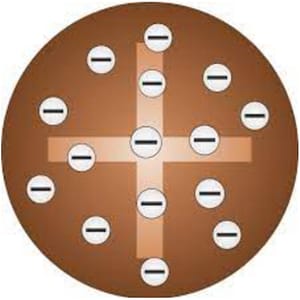
Thomson came up with the “plum pudding” model. He thought atoms were positively charged spheres with electrons inside.
By using a cathode ray tube, he demonstrated that these particles were smaller than atoms and negatively charged.
Ernest Rutherford
Ernest Rutherford followed with his gold foil experiment in 1909.
In this groundbreaking experiment, Rutherford directed a beam of alpha particles at a thin foil of gold.
Most of the particles passed through the foil with little or no deflection, but a small fraction were deflected at large angles, and some even bounced back toward the source.
This unexpected result led Rutherford to conclude that atoms consist mostly of empty space, with a dense, positively charged nucleus at their center.
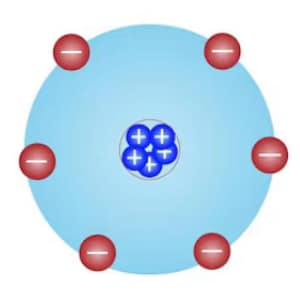

Rutherford’s Atom
Ever wonder what’s really inside an atom?
Rutherford’s revolutionary experiment revealed a mind-blowing truth
Niels Bohr
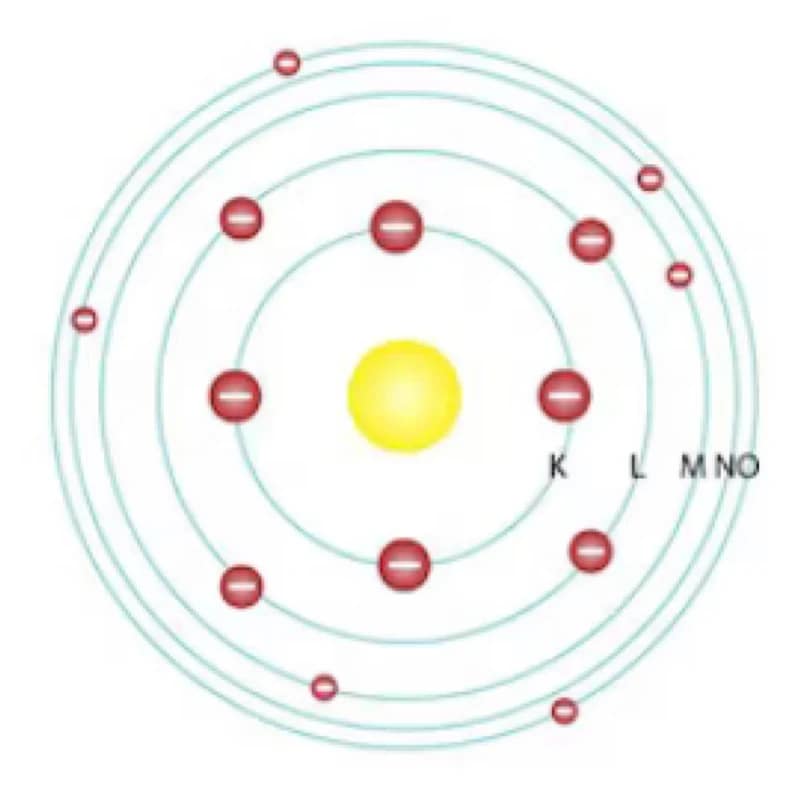
In 1931 Niels Bohr, building on Rutherford’s nucleus-centric model, introduced the idea of electrons orbiting the nucleus in defined energy levels or shells.
This was a significant advance because it incorporated quantum theory into the atomic structure, explaining why electrons do not crash into the nucleus.
It also helped to explain how atoms absorb or emit energy.
The Bohr model, while not entirely accurate in all of its details according to modern physics, provided a framework for future quantum mechanical models.
James Chadwick
Rutherford’s findings prompted further research into the nature of the nucleus, leading to James Chadwick’s discovery of the neutron in 1932, which massively improved our understanding of atomic structure.
Prior to this, the only known components of an atom were thought to be protons and electrons.
The existence of neutrons provided a very important piece of the puzzle, explaining why atoms of the same element can have different mass numbers, a phenomenon known as isotopes.
Later Developments
The development of quantum mechanics in the early 20th century, led by scientists like Werner Heisenberg, Erwin Schrödinger, and Paul Dirac, changed how we understand the atom. Their work brought a new level of detail and precision to atomic theory.
Quantum mechanics replaced the old idea of electrons moving in fixed orbits. Instead, it introduced probability clouds, or orbitals, showing where an electron is likely to be found.
The discovery of subatomic particles changed physics by challenging traditional ideas of matter.
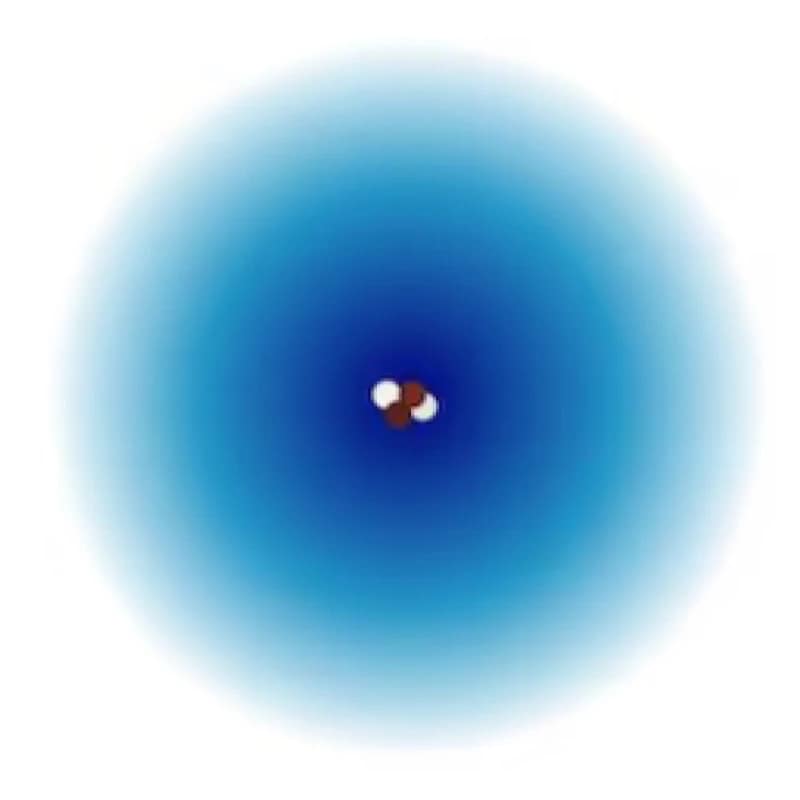
The basic ideas of this quantum mechanical model, which describes the movement of electrons in atoms with remarkable accuracy, are essential to many modern technologies such as semiconductors, computers, and lasers.
Electrons became essential for understanding electricity and chemical bonding.
Protons and neutrons provided information about nuclear reactions and atomic stability. These discoveries paved the way for progress in fields like chemistry, physics, and even medicine.
Atoms Atoms Atoms! – What is An Atom In Chemistry?
The simple definition of an atom in chemistry is:
An atom is the smallest part of a chemical element that keeps the properties of that element.
This means that if an atom were to be split into smaller parts (which is possible), it would no longer represent the same element.
e.g. if you had an atom of iron and smashed it into its smaller particles, it would no longer be the element iron.
Atoms are made up of 3 even smaller sub-atomic particles:
What Is The Typical Size Of An Atom?
Atoms are extremely small.
You cannot see them with your eyes or even the most powerful light microscopes!
The diameter of a typical atom is about 0.1 nanometres, or 1 x 10⁻¹⁰ metres (that is 0.000 000 000 1 metres).
Their size is hard to imagine. To help you picture this, imagine that if an apple were the size of the Earth, an atom in the apple would be about the size of the original apple!
Atoms are so small that a single drop of water contains more atoms than there are grains of sand on all the beaches on Earth!!
If you were to line up hydrogen atoms side by side, 10 million would fit into one millimetre
Here’s a simple table to compare sizes:
| Object | Approximate Diameter |
|---|---|
| Atom | 0.1 nanometres (nm) |
| Human hair | 80,000–100,000 nanometres |
| Red blood cell | 7,000–8,000 nanometres |
Atoms Are 99.9% Empty Space, But Why?
Atoms are mostly empty space, about 99.9%.
This is because the nucleus, in the centre of the atom, is tiny. It’s 100,000 times smaller than the distance of electron orbitals from the nucleus.
If we made an atom the size of a football stadium, the nucleus would be like a pea on the centre spot. This shows how much empty space there is.
Why Do Things Feel Solid If Atoms Are Mostly Empty Space?
The model put forward by Niels Bohr is a simple illustration that many of us learn at school. With the electron moving around a nucleus in a fixed orbit.
Roger Barlow1, a research professor, provides an explanation of the current understanding of atomic structure on the topic. It is not possible to keep track of the electrons because they move around the nucleus at speeds that are so fast that they cannot be tracked.
The electrons don’t orbit the nucleus like planets around the sun instead, they swarm around the nucleus in set patterns to form a cloud
Interactions between the charge on the electrons and the opposite charge of the nucleus of the atom generate electromagnetic forces within the electron cloud
To further simplify, imagine a helicopter in flight; it may only have 2 blades, but they look almost solid when it is flying.
Basic Atomic Structure for Years 9-11: Core Concepts
Learning about atomic structure is key in your science education.
It’s vital to understand what makes up an atom, the properties of its particles, and how they affect the atom and the element it represents.
This knowledge is essential for chemistry and physics.
The Three Main Sub-atomic Particles
Atoms are made of protons, neutrons, and electrons. Each particle has its own location, charge, and function within the atom.
Protons and Their Properties
Protons are found in the centre of the atom, in the nucleus. They have a positive electric charge, shown as +1. A proton’s mass is about 1 atomic mass unit (amu)
How The Number of Protons Identifies An Element
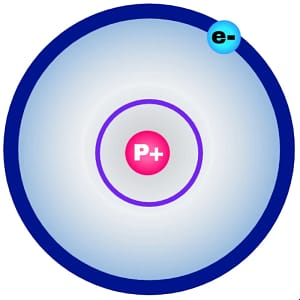
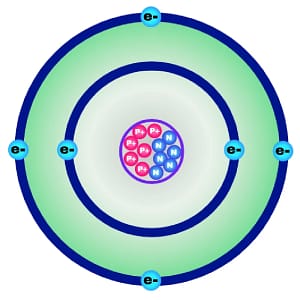
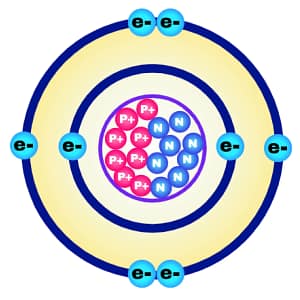
The total number of protons – the proton number – in the nucleus tells you which atom of an element you are dealing with. For example:
An atom with 1 proton is hydrogen.
An atom with 6 protons is carbon.
An atom with 8 protons is oxygen.
The number of protons in an atom is sometimes called the proton number. This number is unique to each element, as no two elements have the same number of protons.
This is Fundamental
The number of protons tells us the atomic number of an element in the periodic table.
This atomic number not only identifies an element but also influences its chemical properties and behaviour.
Their positive charge means they attract negatively charged electrons.
Neutrons and Their Properties
Neutrons are also inside the nucleus in the centre of an atom, alongside the protons. Unlike protons, neutrons have no electric charge; they are neutral.
The Function of Neutrons
Neutrons have about the same mass as protons, so they each add a lot of weight to the atom.
Their neutral charge doesn’t change the atom’s overall charge and has no influence on the identity of an element.
How Neutrons Affect Atomic Stability
Neutrons play an important role in keeping the nucleus stable. The presence of neutrons reduces the electromagnetic repulsion between positively charged protons.
Without enough neutrons, protons would push away from each other due to having the same charges, resulting in unstable nuclei. Therefore, neutrons serve as a buffer, allowing nuclei to exist without breaking apart.
Neutrons and Isotopes
The number of neutrons in an atom can vary, leading to the creation of a type of atom called an isotope.
Isotopes are atoms of the same element with different numbers of neutrons.
For example, the 3 isotopes of carbon: carbon-12 has six neutrons, carbon-13 has seven neutrons, while carbon-14 has eight. Most importantly, as isotopes of carbon they all have 6 protons.
The 3 Isotopes of Carbon
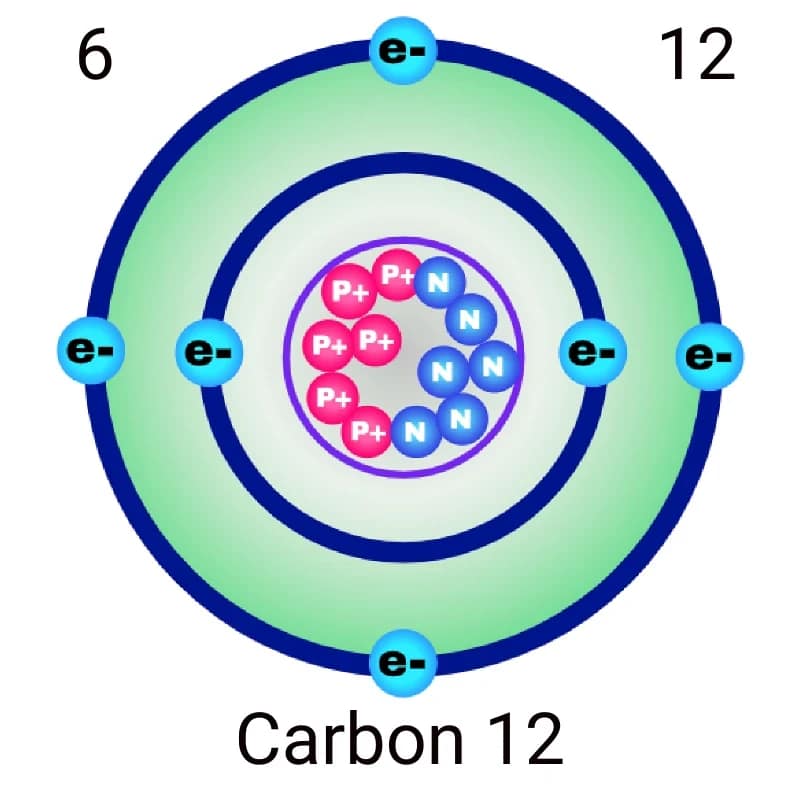
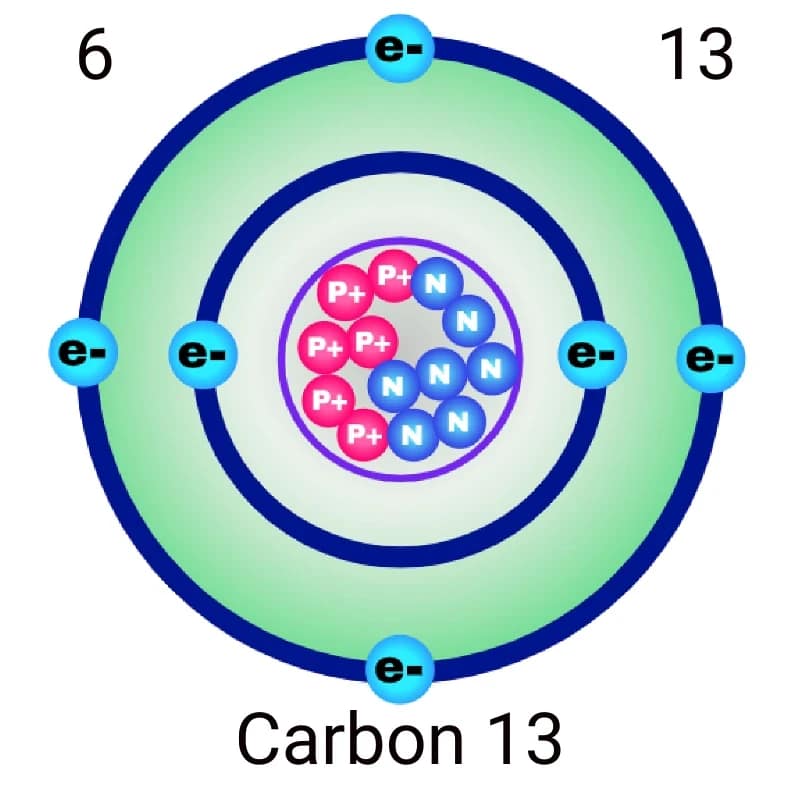
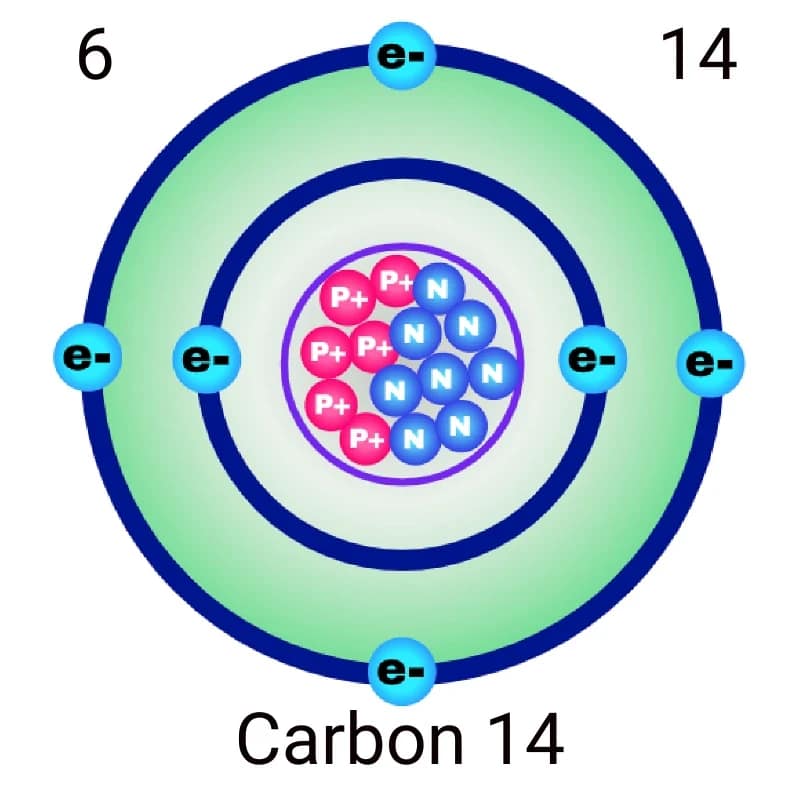
These variations affect the atom’s stability and radioactivity, making some isotopes useful in fields like medicine and archaeology.
Other Atomic Variations of Nucleons (Proton and Neutrons)
Isobars:
isobars are atoms that have the same atomic mass number (A) (atomic mass unit of Protons + atomic mass unit of Neutrons) but different atomic numbers (Z) (number of protons).
An example of this are the elements Argon-40 and Potassium-40. They both have an atomic mass of 40, but their atomic numbers (Z) are different.
| Element | Atomic Number | Number of Protons | Number of Neutrons | Atomic Mass Number |
|---|---|---|---|---|
| Argon-40 | 18 | 18 | 22 | 40 |
| Potassium-40 | 19 | 19 | 21 | 40 |
Isotones:
Isotones are atoms that have the same number of neutrons but different atomic numbers (Z) (number of protons).
An example would be Carbon-14 and Nitrogen-15, both contain 8 neutrons but have different numbers of protons.
| Element | Atomic Number | Number of Protons | Number of Neutrons | Atomic Mass Number |
|---|---|---|---|---|
| Carbon-14 | 6 | 6 | 8 | 14 |
| Potassium-15 | 7 | 7 | 8 | 15 |
Neutron-to-Proton Ratio
The number of protons compared to the number of neutrons must be in the right amount for an atom to be stable.
For elements with a low atomic number (a low number of protons in the nucleus), each proton in the nucleus requires one neutron to maintain a stable 1:1 ratio.
But, as the number of protons increases (atomic number grows), more neutrons are needed to keep the atom stable. This is because the repulsive forces between the higher number of protons increases.
Neutrons are important in nuclear reactions, like fission and fusion (splitting or joining atoms).
They can leave or enter the nucleus of an atom, leading to changes in the element or isotope. This property is used in nuclear power and radioactive dating.
Electrons
Electrons are essential for understanding the chemical properties of elements and how they interact with one another.
Electrons: Properties and Behaviour
Electrons are the tiny, negatively charged particles, shown as -1. They orbit the nucleus of an atom in what are called electron shells or orbitals.
Electrons have a very small mass compared to protons or neutrons—at about 1/1836 the mass of a proton, they add very little to the atomic weight of an atom
The number of electrons in a neutral atom is equal to the number of protons.
However, if electrons are gained or lost, the atom becomes what is known as an Ion.
Unlike atoms, ions have an overall charge because the number of protons and electrons is not equal.
The arrangement of electrons in an atom affects how atoms bond or react.
Relative Mass and Charge of Particles
Each subatomic particle has a different mass and electric charge. Below is a table to help you compare them:
| Particle | Location | Relative Mass | Charge |
|---|---|---|---|
| Proton | Nucleus | 1 | +1 |
| Neutron | Nucleus | 1 | 0 |
| Electron | Outside Nucleus | ~1/1836 | -1 |
Protons and neutrons make up nearly all the mass in an atom, as electrons are extremely light.
The positive charge of protons balances out the negative charge of electrons, so a normal atom is neutral overall.
The Nucleus of An Atom
The nucleus is found in the centre of an atom. Packed with protons and neutrons (also known as nucleons).
Protons and neutrons make up the majority of the atom’s total mass.
As the protons are positively charged and the neutrons have no charge, the overall charge on the nucleus is positive. This charge is essential for the stability of the atom.
The positive charge of the nucleus attracts the negatively charged electrons, which orbit around it, resulting in a balanced structure of the atom
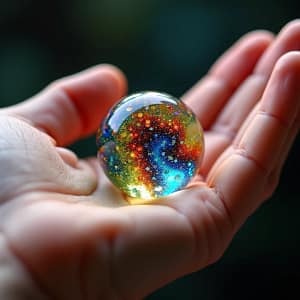
This central core is incredibly dense, much more so than any other part of the atom.
To put it into perspective, if you could scale up a nucleus of an atom to the size of a marble, it would weigh approximately a million tonnes!
The nucleus is held together by the strong nuclear force, one of the four fundamental forces of nature.
This force causes the high density of the nucleus and is extremely powerful at short distances, overcoming the repulsion between the positively charged protons and ensuring the stability of the nucleus.
However, because it operates at such short distances, larger nuclei can sometimes become unstable and undergo radioactive decay.
Why Understanding Atomic Structure Matters
Behind every medical breakthrough and tech innovation lies a fundamental truth—atomic structure shapes our world.
Understanding how elements combine at an almost invisible scale can provide solutions to global challenges.
In pharmaceuticals, atomic knowledge designs lifesaving drugs.
By modelling how molecules fit into protein receptors, scientists create targeted therapies. Cancer treatments like cisplatin rely on platinum’s electron configuration to disrupt DNA.
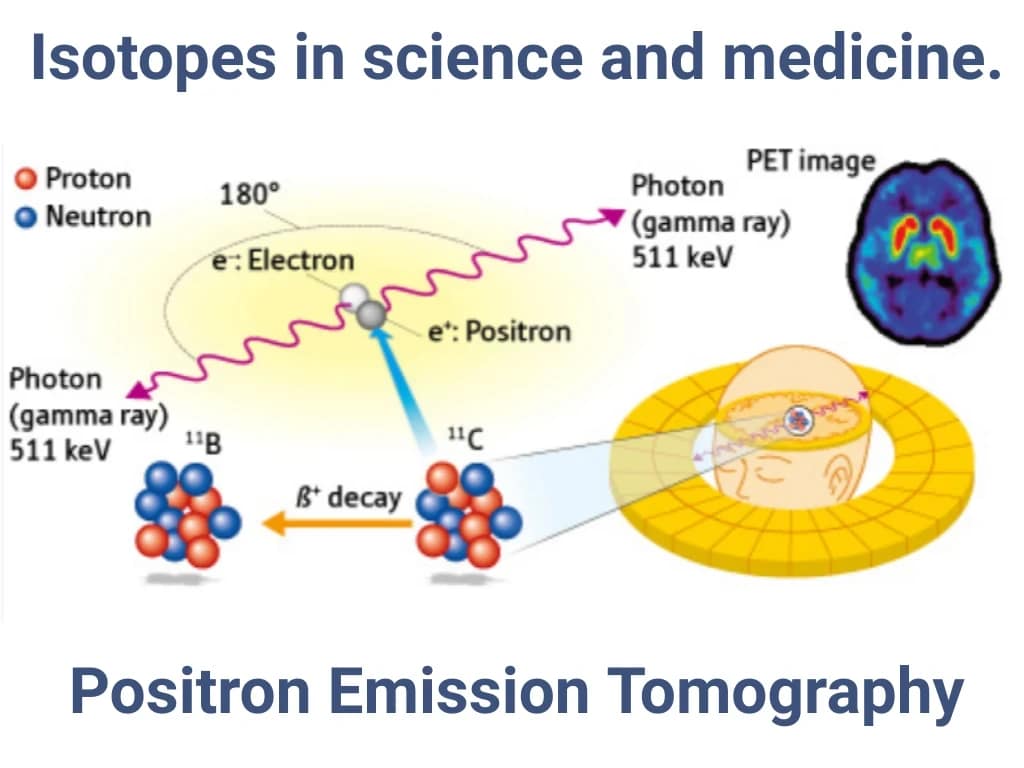
The use of isotopes in science and medicine.
They can be used to determine the age of ancient artefacts through radiocarbon dating, as well as in medical imaging and treatments like PET (Positron Emission Tomography) scans and cancer therapies.
Cancer treatments like cisplatin rely on platinum’s electron configuration to disrupt DNA.
Their unique properties enable scientists to study reactions and processes at the atomic level, thereby expanding our understanding of chemistry and biology.
Semiconductor manufacturing depends on silicon’s atomic properties.
Precisely doping it with phosphorus or boron controls conductivity. Your smartphone’s processor contains billions of such engineered atoms.
Materials science innovations include:
Environmental monitoring tracks pollutants using atomic absorption spectroscopy. This chemistry technique identifies heavy metals in water at parts-per-billion levels.
From clean energy to quantum computing, manipulating matter at atomic scales drives progress. What appears theoretical in textbooks becomes real in laboratories and factories around the world.
To Wrap Things Up
You’ve now explored the fascinating world of atoms, from their tiny protons and neutrons to the buzzing electrons that define their behaviour.
Remember that the atomic number is more than just a digit; it is an element’s fingerprint, indicating its properties and position on the periodic table.
These are not just textbook ideas. They explain how iron rusts, neon glows, and carbon can form diamonds and pencils.
Want to dive deeper?
Try comparing lithium and sodium—their similar outer electron arrangements reveal why they react alike.
Continue to ask questions as you move forward. The quantum world, where particles defy conventional physics, awaits your curiosity.
Every material, every reaction, starts with the humble atom—your gateway to understanding the universe’s building blocks!
References
1. Barlow, R. (n.d.). If atoms are mostly empty space, why do objects look and feel solid? [online] The Conversation. Available at: https://theconversation.com/if-atoms-are-mostly-empty-space-why-do-objects-look-and-feel-solid-71742.
0 Comments